A simple, powerful method that makes mastering multiplication easier and faster for every student
3 min read
77 views
AJ
Aji Ene
You might be wondering why an adult would bother revisiting the multiplication table. Well, this story begins with a challenge. After the holidays, I had just two weeks to prepare an 8-year-old student for the Loyola Jesuit College entrance exams. One look at past questions was enough to raise concern many of the Mathematics questions were far beyond what you would expect for a child moving from Primary 4 to JSS1. To make things more interesting, the child didn’t like Mathematics and struggled with multiplication tables, especially from 6 and above. However, the child was brilliant in every other subject. This meant one thing: we needed a fast, simple, and effective way to master multiplication no excuses.
The Simple Trick Behind the 9 Times Table
We started with something familiar—the popular 9 times table trick. It’s a method that makes multiplication feel almost automatic. The idea is simple: write numbers 0 to 9 in ascending order under the Tens (T) column, and then write them in reverse (9 to 0) under the Units (U) column. When combined, they form the full answers to the 9 times table from 9 × 1 to 9 × 10. For example: 09, 18, 27, 36, 45, 54, 63, 72, 81, 90. It’s quick, visual, and easy to remember. At that moment, I wished I had known this method back in primary school.
9 multiplication table
Introducing Ajiene’s Law (For 2–8 Times Tables)
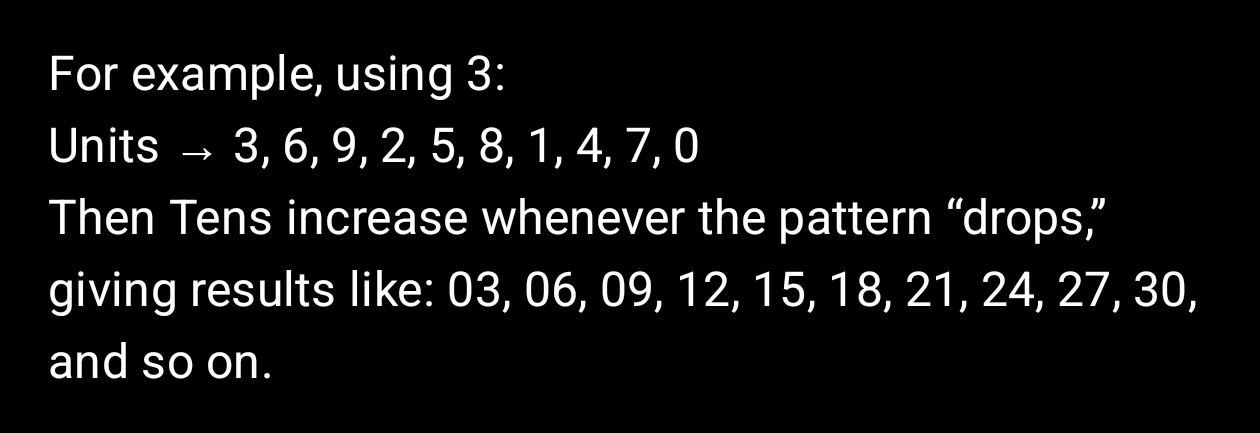
While the 9 times table trick was helpful, there was nothing simple enough for the 6, 7, and 8 times tables. So I developed a new approach—Ajiene’s Law of the Multiplication Table. The idea starts with writing numbers from 1 to 9, followed by 0. Then, for any number (like 2, 3, 4, etc.), you count in steps and record the pattern until you reach 0. For example:
Interestingly, some patterns are reversals of others. For example, the sequence for 6 is the reverse of 4, 7 is the reverse of 3, and 8 is the reverse of 2 (all ending in 0). This pattern recognition makes learning faster and more intuitive.
How to Apply the Method Easily
To use Ajiene’s Law, start by filling the Units (U) column using the sequence of the number you’re working with. Then, fill the Tens (T) column starting from 0. Each time the unit digit becomes smaller than the one above it, increase the tens digit by 1. This creates a consistent and predictable pattern that builds the full multiplication table step by step.
The same method works for 4, 5, 6, 7, and 8. With practice, students begin to “see” the pattern instead of memorizing blindly.
Making Mathematics Simple and Fun
In just a short time, this method transformed how the student approached multiplication. What once felt difficult became predictable and even enjoyable. That’s the power of simplicity and pattern-based learning.
Ajiene’s Law isn’t just a trick it’s a smarter way to understand numbers. Whether you’re a student, teacher, or parent, this approach can make a huge difference. Try it out with 5, 6, 7, and 8, and see how quickly the patterns come alive.
Mathematics doesn’t have to be hard sometimes, all it takes is the right method to unlock a child’s confidence and potential.